
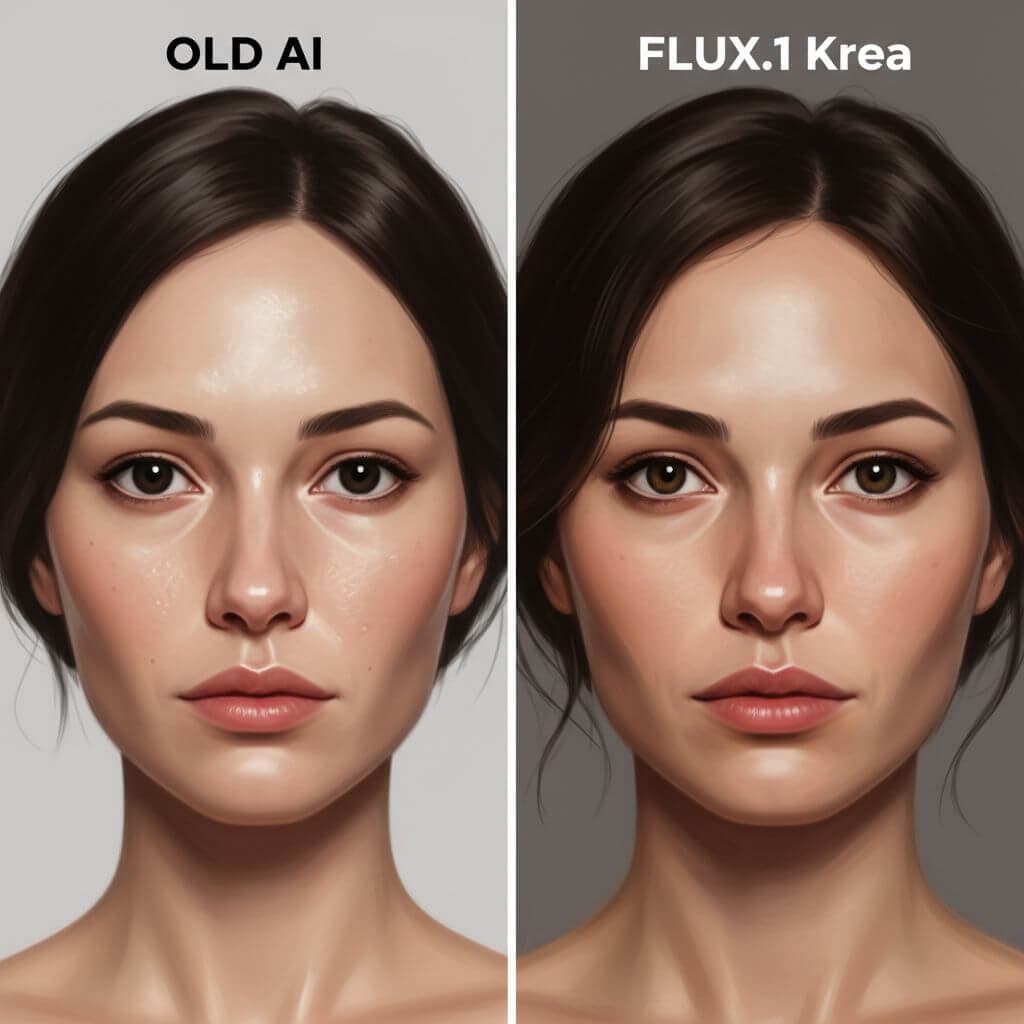
Goodbye "AI Plastic Feel": Krea AI & Black Forest Labs Open Source the FLUX.1 Model
On this page
Share
Are you tired of spotting that "AI face" from a mile away?
Whether it's the stiff expressions, overly smooth skin, or the soulless, uncanny valley eyes, this uniform "plastic feel" has long been a pain point in AI image generation.
Now, Krea AI and Black Forest Labs have joined forces to deliver a revolutionary solution: FLUX.1 Krea [dev]. This isn't just another image model; it's an open-source project designed to definitively end the "plastic feel" and bring natural, artistic life back to AI creation.
What is FLUX.1 and Why Is It Special?
FLUX.1 is a powerful image generation model with a core mission: to solve the "aesthetic fatigue" problem prevalent in current models.
Traditional AI models are often trained in a "one-pot stew" approach on massive datasets. This teaches them a sort of "average beauty" but causes them to lose the personality and natural imperfections that define reality. FLUX.1 takes a completely different strategy.
The Innovative "Breadth First, Then Depth" Two-Stage Training
The magic of FLUX.1 comes from its unique two-stage training method, much like training a real artist:
Stage 1: Breadth (Large-Scale Pre-training)
First, the model learns on an incredibly vast and diverse dataset. This allows it to master the fundamental knowledge of the world—from the shapes and colors of objects to the physical laws of light and shadow. This is the "breadth" phase for building a solid foundation.
Stage 2: Specialization (Aesthetic Fine-Tuning)
This is the crucial step. After mastering the basics, FLUX.1 undergoes "specialized" training on a smaller, but extremely high-quality, dataset. This dataset is meticulously curated, filled with images that possess true artistic value and natural beauty.
To achieve this "aesthetic fine-tuning," the team used two advanced techniques:
- SFT (Supervised Fine-Tuning): This helps the model learn to follow more nuanced instructions and understand abstract concepts like "artistic feel" or "natural."
- TPO (Tuned Preference Optimization): This is a proprietary RLHF (Reinforcement Learning from Human Feedback) technique developed by Black Forest Labs. In simple terms, it teaches the model "what humans perceive as beautiful," pushing it to prefer generating images that are less stiff and more infused with lively, artistic details.
Why Does This Matter to You?
The open-sourcing of FLUX.1 means that developers, designers, and hobbyists alike can now leverage this model to create images that are more vibrant, more authentic, and have that "AI taste" removed.
This isn't just a technical victory; it's an artistic comeback. It brings us one step closer to the true potential of "AI creation"—not as cold replicas, but as works filled with warmth and personality.
Experience the Magic of "De-AI-ing" Yourself
Want to experience this magical "de-AI-ing" power for yourself?
You can try the flux kontext model right now at Flux Kontext and see firsthand how FLUX.1 breathes new life into images, leaving the stiffness behind.
Transform Your Images with AI
Turn sketches into stunning images, remove backgrounds, swap faces, and more — all powered by AI.
Try Sketch To FreeShare
wujieli
Tech writer covering AI tools, image processing, and creative workflows.
Related Articles

Seedream 4.0 Deep Dive: Redefining the Art of AI Image Generation
Explore the powerful features of the Seedream 4.0 model. This guide breaks down its new breakthroughs in photorealism, prompt understanding, and style versatility, and shows you how to start using it today.
What Is Nano Banana AI? An In-Depth Look at This Revolutionary Image Model
Discover Nano Banana AI, the powerful new image generation model. Learn how it works, what makes it unique, and how you can start creating stunning images for free.

Knitted Doll AI Prompt: 7 Templates That Work
Use this knitted doll AI prompt guide to turn photos or sketches into cozy yarn dolls. Includes 7 templates, material words, and fixes.