
Reverse Engineering Prompt: What It Is and How to Do It
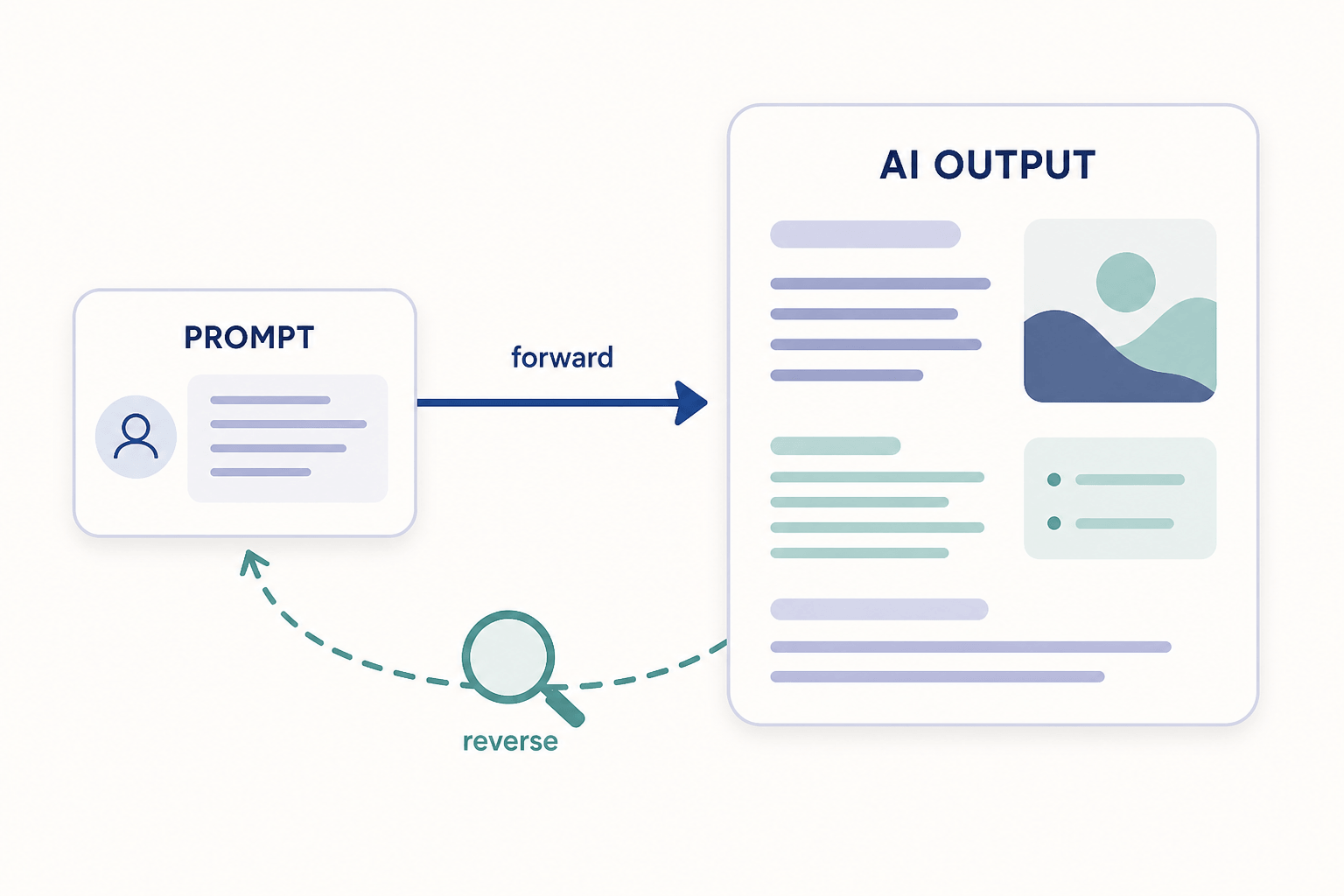
You saw an AI output — a story, a summary, a perfectly structured answer — and wondered what prompt was behind it. Working that out backwards is called reverse engineering a prompt, and it is also known as reverse prompt engineering (RPE). In plain terms: reverse engineering a prompt is the practice of analyzing an AI-generated output to infer the prompt that likely produced it, without access to the model's internals.
The idea matters because prompts are invisible in almost everything you read. Articles, product pages, study notes, social posts — a growing share was produced by language models, and the instruction that shaped each output is hidden. Reverse prompt engineering turns that hidden instruction into a guess you can learn from, and researchers have formalized the technique well enough that it now works from as few as five text outputs.
Key takeaways
- Reverse prompt engineering (RPE) reconstructs the prompt behind an output by analyzing the output alone — no access to model internals required.
- The documented research method is iterative: generate candidate prompts, compare their outputs against the originals, keep refining. One published framework does this with a genetic-algorithm-inspired loop and no model training.
- You can apply a lighter manual version today using a fixed checklist: format, audience, assumptions, tone, domain knowledge, then candidate and alternative prompts.
- RPE works best on natural-language text. Inferring the prompt behind a generated image is far more speculative.
Prompt engineering vs reverse prompt engineering
The two are complementary sides of the same skill. Standard prompt engineering is constructive: you build a prompt to get a desired output. Reverse prompt engineering is analytical: you start from an existing output and infer what was likely asked.
| Aspect | Prompt engineering | Reverse prompt engineering |
|---|---|---|
| Starting point | A goal or task you want the AI to perform | An existing AI-generated output |
| Objective | Design a prompt that produces the result you want | Infer the prompt or reasoning behind a given result |
| Typical use | Generating content, solving problems | Debugging, learning, analyzing, improving prompt quality |
| Mindset | Constructive: "What should I ask?" | Analytical: "What was likely asked?" |
Because many different prompts can steer a model toward similar outputs, a reconstruction is always a strong hypothesis — not a recovered secret.
How researchers reconstruct prompts
The formal version of this technique comes from research on language model inversion. A 2024 paper by Li and Klabjan introduced a training-free framework that reconstructs prompts using only a limited number of text outputs, under strict black-box conditions — no logits, no weights, no system prompt. The method described below follows Learn Prompting's step-by-step walkthrough of that framework; it is documentation-based, meaning we're explaining the documented procedure rather than reporting our own test runs.
The setup: a hidden prompt produces several outputs from the same model. The goal is to reconstruct an approximation of that prompt using the outputs alone. The method then improves through four stages.
1. One answer, one guess. The simplest attempt infers the prompt from a single output. It usually overfits. In Learn Prompting's example, a hidden prompt asking for "three common startup challenges" produced the answer "Funding, hiring, and scaling" — but a prompt reconstructed from that single output came back as "What are three startup challenges in customer service and cybersecurity?", inventing specifics that were never there.
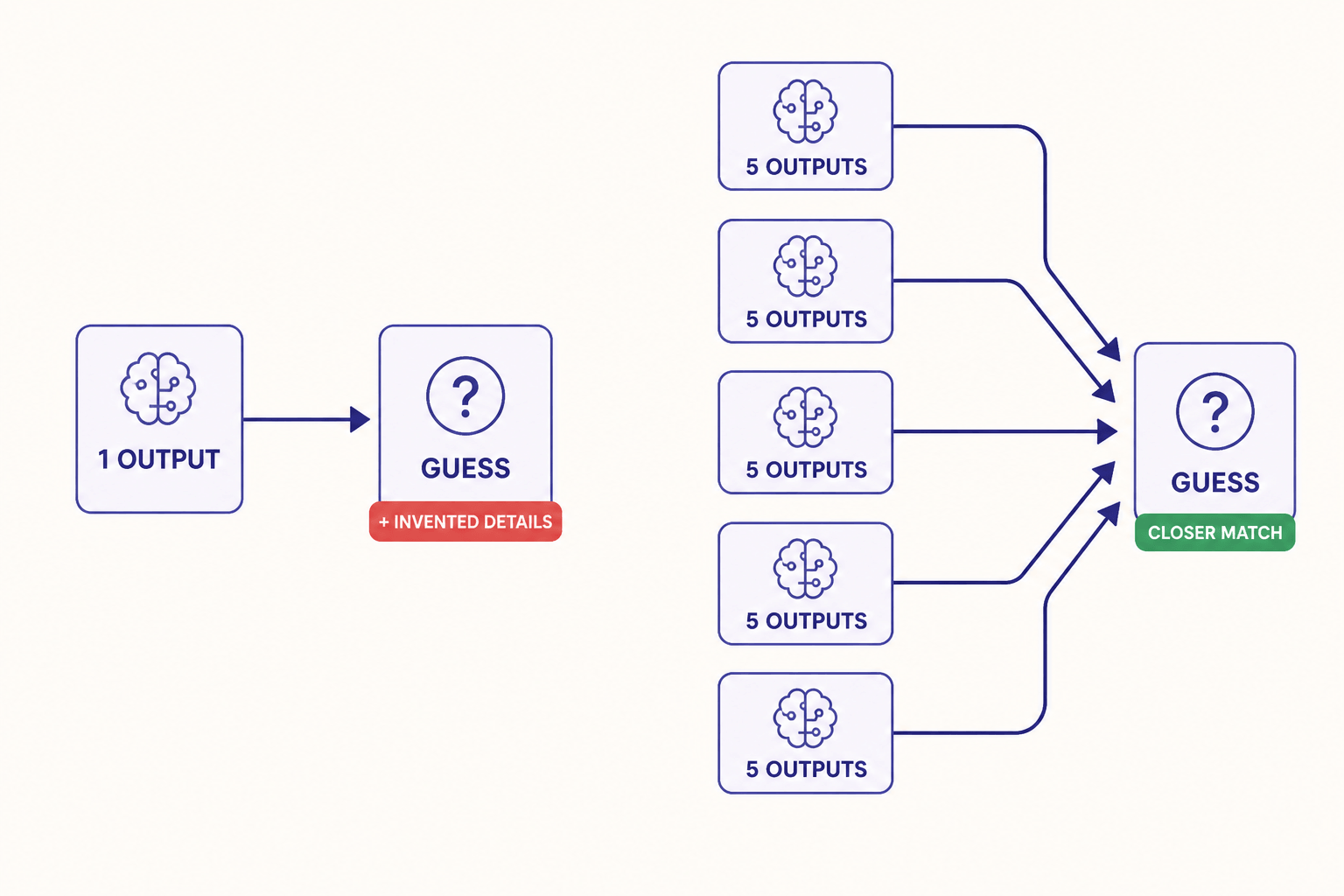
2. Five answers, one guess. Run the same hidden prompt several times and infer from all outputs at once. Randomness makes each run slightly different, but the overlaps point back to what the prompt actually asked. A reconstruction from five outputs landed on "What are three startup challenges?" — much closer to the original.
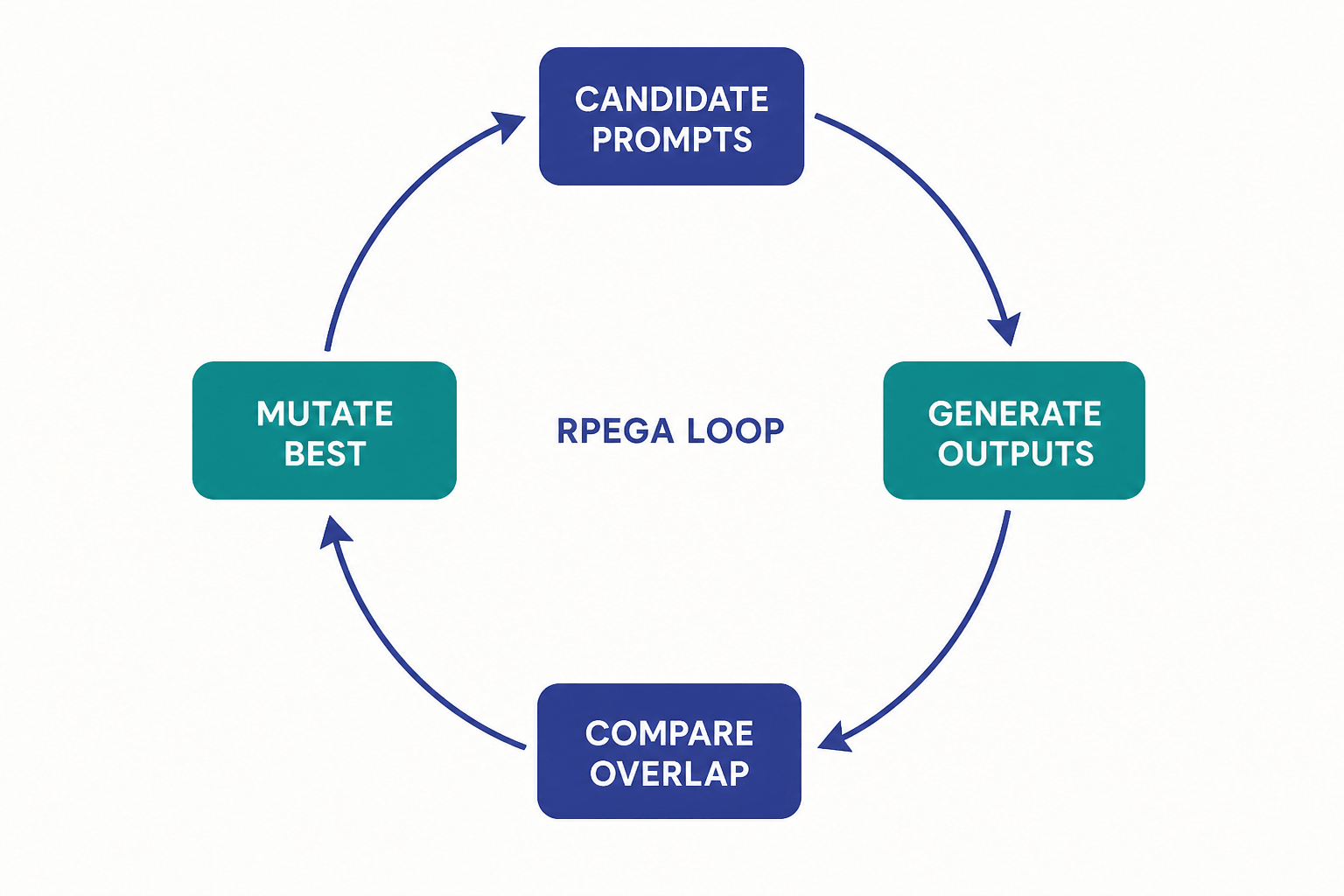
3. Five answers, five candidates. Instead of committing to one guess, generate several candidate prompts and pick between them. The comparison is mechanical: each candidate generates new outputs, and word overlap with the original outputs (measured with ROUGE-1) decides the winner.
4. Iterative refinement (RPEGA). The full framework wraps these steps in an optimization loop inspired by genetic algorithms: start from candidate prompts, generate outputs, score them against the originals, mutate the wording of the best candidates, and repeat. Each pass moves the reconstruction closer to the original prompt's meaning.
What makes this approach notable is what it doesn't need. Earlier inversion methods relied on internal signals like logits or on large datasets of example outputs; the RPE framework needs neither and involves no model training, which is exactly why it can be pointed at proprietary, closed-source models.
A manual method you can use today
You don't need an optimization loop to think backward usefully. For ordinary content — an article, a manual, a glossary entry — practitioners use a structured reading pass. A checklist published in tcworld magazine reduces it to seven questions, which turn into a short workflow:
- Identify the format of the output (manual, glossary, story, procedure, API reference).
- Infer the intended audience from vocabulary and assumed knowledge.
- List the assumptions the content makes about the reader.
- Note the tone and style — plain, formal, playful, clinical.
- Ask what domain knowledge is implied.
- Draft the prompt that would most plausibly produce this output.
- Write at least one alternative prompt that could produce something similar — this keeps you honest about uncertainty.
A reusable analysis prompt, with variables in brackets, adapted from the worked examples in that article:
You are analyzing an AI-generated output. Given the following [OUTPUT],
infer: the likely prompt that produced it, the intended audience,
the tone and formatting conventions used, and any domain knowledge
the prompt must have requested. Then propose one alternative prompt
that could plausibly produce a similar result, and state which
details of your inference are uncertain.
The last sentence is the important one. It forces the model (and you) to separate confident inference from guesswork — which is exactly the discipline manual RPE needs.
What people use it for
The documented applications fall into three groups:
- Security and adversarial research. Understanding what a hidden prompt does helps researchers reason about vulnerabilities — what a system can be steered to reveal or do.
- Prompt recovery and optimization. When an output is genuinely good, reconstructing the prompt behind it lets you reuse, tune, or adapt that instruction for related tasks.
- Learning from strong content. Deconstructing an excellent article or piece of documentation exposes the instruction patterns behind it — audience, structure, tone — which sharpens your own prompt design.
Can you reverse engineer an image prompt?
Short answer: not reliably, and the sources are unusually blunt about it. The tcworld analysis states that RPE is most effective with natural language, and that inferring the prompt behind a generated image or a complex code snippet is "far more speculative," requiring deep domain expertise and assumptions about the model's capabilities.
The reasons are structural. Text models show their reasoning in the output itself; image models don't. The space of prompts that could plausibly produce a given image is enormous, and the decisive variables — style presets, negative prompts, seed values, model-specific parameter handling — are invisible in the output. Two prompts that read completely differently can produce near-identical images on the same model.
That doesn't make the backward direction useless for images; it makes it a heuristic. Practical approaches people use: describe the image carefully and treat the description as a draft prompt, iterate from there, and pay attention to the wording patterns that keep appearing in prompts for the style you want. Prompt wording remains the main lever you control in any image workflow — whether you're writing it from scratch in a generator, or pairing a prompt with a reference sketch in a tool like SketchTo's Sketch to Render. The difference is that forward prompt-writing gives you feedback you can act on; backward inference from an image usually doesn't.
Limits worth knowing before you trust a reconstruction
Every reconstruction inherits the same four weaknesses, documented across the sources above:
- Multiple valid prompts. "Summarize this article in plain English" and "Give me a concise overview of the main points" produce similar results. Similarity of outputs does not identify the prompt.
- Ambiguous outputs resist reconstruction. A generic sentence like "Innovation is key to success" could come from prompts about business strategy, motivational writing, or startup culture — there is nothing to latch onto.
- Hidden context stays hidden. System prompts, temperature settings, conversation history, and retrieved documents in RAG pipelines all shape outputs, and RPE sees none of them.
- Bias without a root cause. A reconstruction can surface biased patterns in outputs but cannot tell you whether they came from the prompt, the training data, or the model's reasoning.
Treat RPE as a diagnostic tool: it narrows the space of plausible prompts and exposes structure and intent, but it does not expose the actual instruction or the parameters that shaped it.
The takeaway
Reverse prompt engineering answers a simple question with structured method: given what the model produced, what was it asked? Researchers refine reconstructions mechanically, from a handful of outputs, with no access to the model's internals. You can apply the same backward thinking to any output with a seven-question checklist — and the same technique will tell you honestly when to stop trusting its answers, most clearly in image generation, where the prompt behind a picture stays mostly out of reach.
Transform Your Images with AI
Turn sketches into stunning images, remove backgrounds, swap faces, and more — all powered by AI.
Try Sketch To FreeShare
SketchTo Team
Tech writer covering AI tools, image processing, and creative workflows.
Related Articles

AI Action Figure Generator Prompt: The Copy-Paste Template (Plus a No-Prompt Shortcut)
A working action figure prompt for ChatGPT and Gemini — packaging, accessories, base, and pose wording explained — plus honest caveats and a preset-style generator shortcut.

How to Turn a Photo Into Pop Art (Warhol-Style Prompts and Fixes)
Learn how to turn a photo into pop art with copyable Warhol, comic halftone, and WPAP prompts — plus fixes for face collapse, dense dots, and flat filter results.

Harry Potter Anime AI: What the Malfoid Trend Is and How to Make Your Own Clips
The Harry Potter anime clips on your feed are AI fan works, not a real anime. What the Malfoid trend is, why it exploded in October 2026, the workflow and prompts behind it, and the IP rules worth knowing.